
HiPinny Journal
How to Choose Glitter Colors That Match Pantone Closely
How to Choose Glitter Colors That Match Pantone Closely
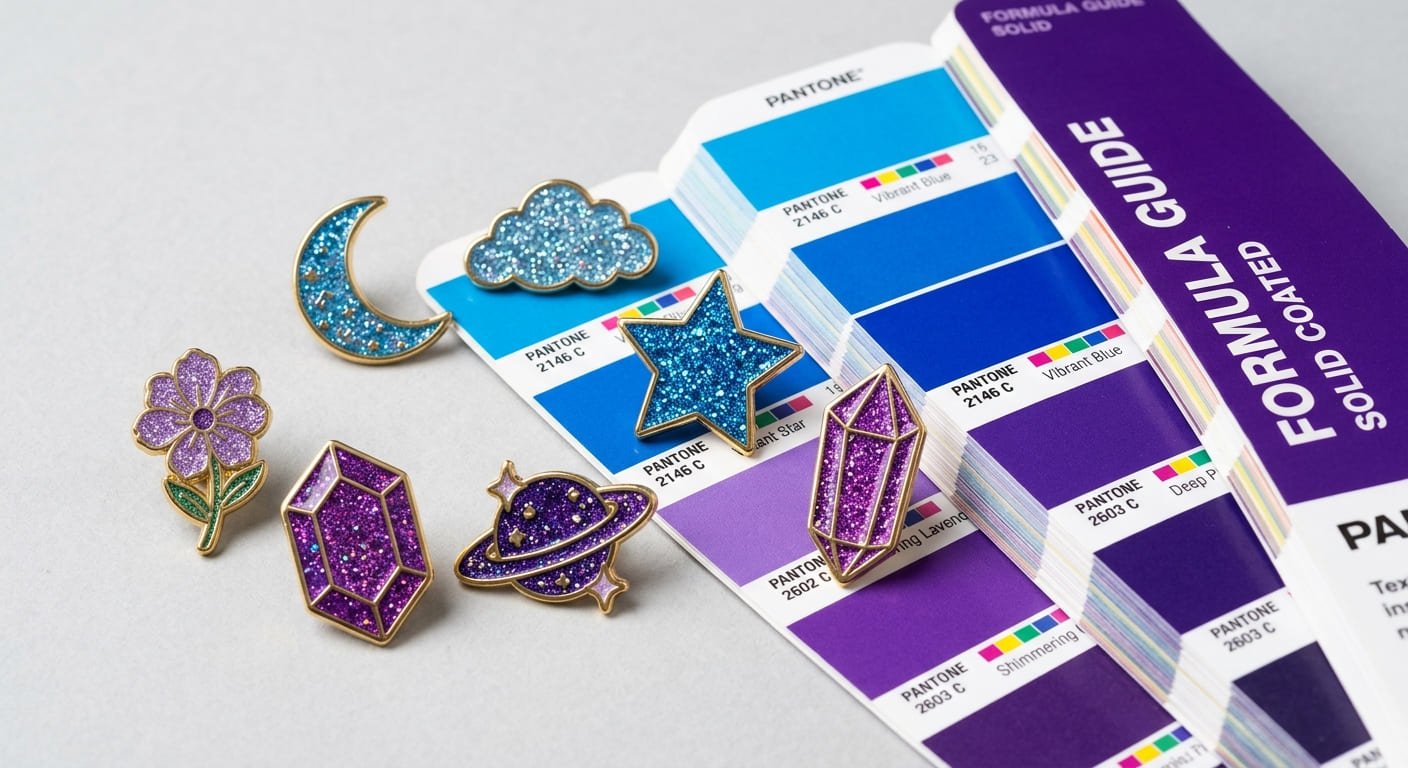
Struggling to get glitter effects that align perfectly with Pantone colors? You're not alone. Many designers and badge manufacturers face challenges when trying to replicate Pantone shades using glitter enamel. The key is understanding why exact matches are difficult and how to make informed choices to get as close as realistically possible.
Pantone colors rarely match glitter applications perfectly due to differences in material composition and reflective properties1—setting realistic expectations and working with trusted manufacturers is essential for minimizing mismatches.
Designers need insight into how glitter materials interact with light, texture, and color perception. Here’s everything you should know so your next glitter pin project balances creativity with practical outcomes.
Why is matching Pantone colors to glitter so challenging?
Pantone colors are a universal standard, but they don’t translate perfectly across materials.
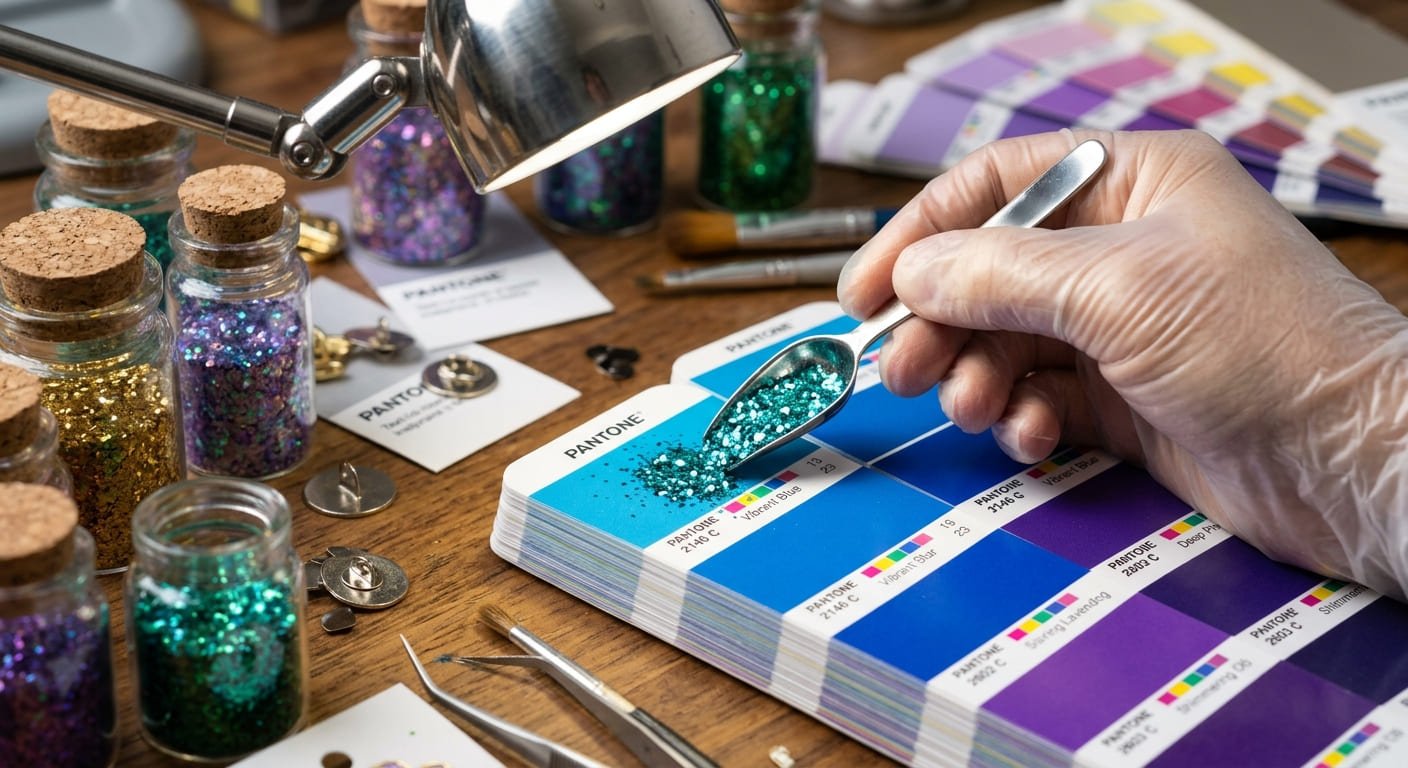
Pantone specifications are ink-based and calibrated for consistent color perception under specific lighting conditions2. Glitter, however, reflects light differently and depends on materials like metal or synthetic flakes, which distort the color.
Glitter’s unique properties vs. Pantone standards
When translating Pantone shades into glitter pins, the primary issue stems from how glitter interacts with light:
- Reflective variability3: Unlike ink, glitter contains reflective particles that scatter light, creating visual shifts depending on the angle.
- Material influences4: The base under the glitter—whether metallic or matte—can alter how the color appears when viewed under different lighting.
- Textural distortions5: Shimmer and sparkle effects change the uniformity of the color.
These factors make it nearly impossible to achieve a perfect one-for-one match, even when using high-quality materials or custom pigment mixing.
Setting client expectations upfront
Many clients come into our manufacturing process expecting Pantone precision. However, by walking them through the limitations, we help designers understand that glitter adds a layer of variability to the color spectrum. This expectation-setting process makes collaboration smoother while ensuring better satisfaction with the final product.
How do manufacturers minimize mismatches?
While perfection isn’t achievable, manufacturers like us use strategies to narrow the gap between Pantone colors and glitter applications.
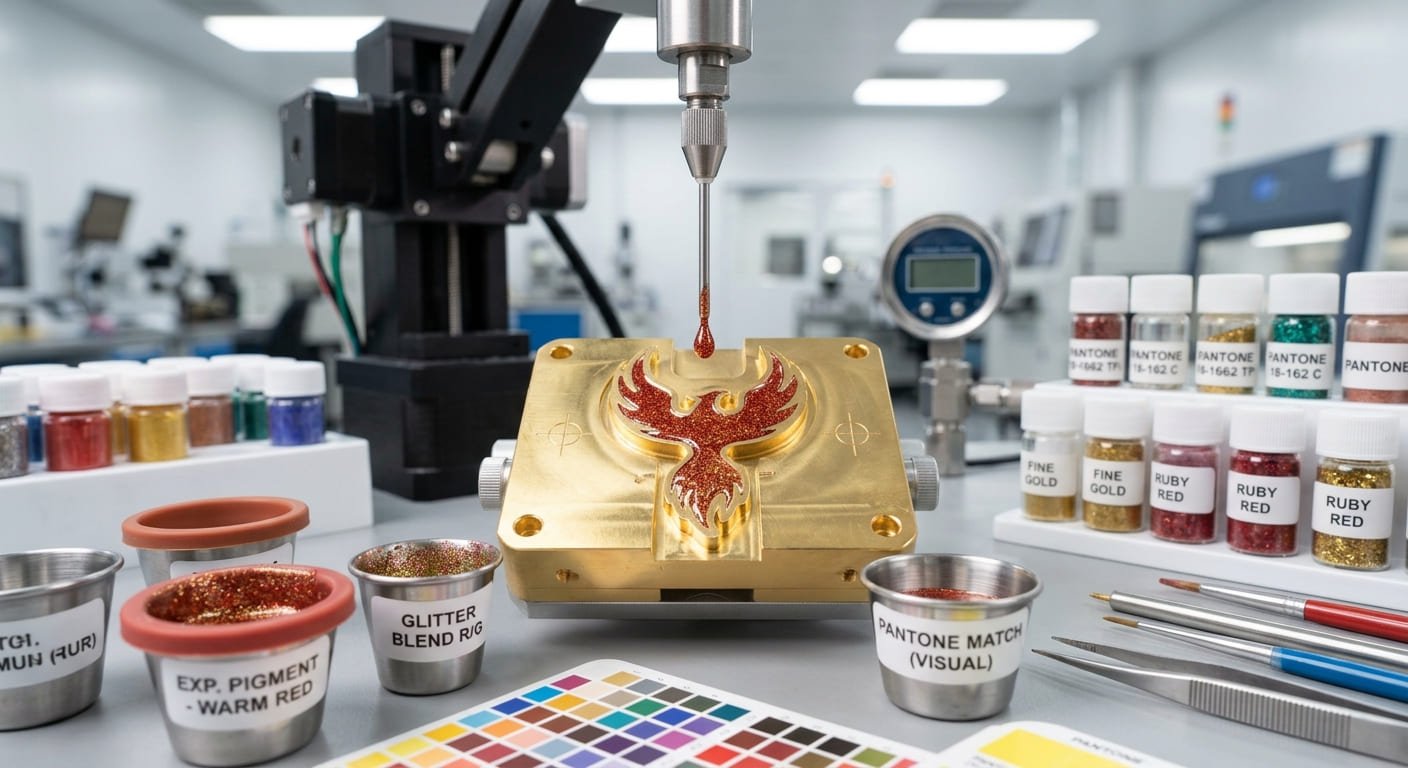
By combining meticulous material selection, color comparison under controlled lighting, and transparent communication6, manufacturers can more closely align glitter effects with design goals.
Steps our factory takes to recreate glitter-based Pantone shades
Here’s how we approach Glitter-Pantone color challenges in practice:
-
Color samples before production7
We compare glitter samples to the requested Pantone color under various lighting conditions, including daylight and fluorescent lighting, for a realistic view of the differences. -
Custom mixing of glitter pigments8
While pure Pantone shades in glitter are impossible, blending pigments can approximate the color families. For example, if a client requests Pantone 485C (a vivid red), we might blend lighter metallic flakes with red glitter to achieve a closer match. -
Material-based adjustments9
The backing finishes—whether silver, gold, or matte enamel—can shift the final appearance. We collaborate with customers to choose the optimal finish for their design vision. -
Customer involvement in approvals10
Close collaboration ensures customer input during adjustments. We typically send photos or videos of glitter-matched samples to confirm changes before full production. -
Scalability checks for large orders11
Glitter color consistency can vary slightly based on volume. During QA reviews, we verify that larger batches maintain as much uniformity as possible to prevent unwanted variances across units.
What factors should you consider when choosing glitter colors?
Choosing the right glitter color isn’t just about picking something visually attractive; it requires balancing design aesthetics with manufacturing realities.
Designers should evaluate factors like base material, lighting conditions for final usage, and tolerance for slight visual variances when selecting glitter colors inspired by Pantone.
Key considerations when choosing glitter for enamel pins
- Pin function and visibility: Determine whether the pin will appear under natural daylight, indoor lighting, or stage lighting—this can drastically affect glitter perception.
- Testing with prototypes: Don’t skip the prototyping stage; glitter reflects differently in digital artwork vs. the final product.
- Color adjustment tolerances: Be flexible with design tweaks. For example, leaning toward slightly lighter or darker glitter adjustments can often yield better visual harmony.
- Material influences on reflectivity: Glitter particles and backing metals create compound reflective effects, which shift perception compared to flat Pantone hues.
Example from our manufacturing experience
A client recently requested glitter pins based on Pantone 209C, a deep burgundy shade. During production, the red glitter appeared more vibrant due to the gold backing used. To mitigate this, we adjusted the glitter mix with darker flakes and provided updated samples. Though it wasn’t a perfect Pantone match, the client ultimately approved the richer burgundy shade as a successful creative compromise.
Frequently Asked Questions
Will Pantone colors ever align perfectly with glitter finishes?
No, due to glitter’s reflective properties, exact alignment with Pantone ink standards is impossible. However, manufacturers can approximate the desired shade using techniques like pigment blending and controlled lighting evaluations.
What affects glitter color perception the most?
The biggest factors are viewing angle, lighting conditions, glitter type (metallic vs. synthetic), and the underlying backing material. Each of these alters how light interacts with the glitter particles.
Can I request custom glitter mixing to get closer to Pantone?
Yes, many manufacturers offer custom pigment mixing to narrow the gap between glitter and Pantone shades. However, slight variations should still be expected.
Do different lighting conditions affect glitter colors?
Absolutely. Glitter colors often shift in brightness or warmth under daylight, fluorescent, or LED lighting due to their reflective nature. It is useful to test samples under multiple lighting types before deciding.
How do I verify color accuracy before large-scale production?
Request physical samples or prototype batches to evaluate how closely the glitter colors align with your Pantone goals. Clear communication with your supplier is key to managing expectations.
Conclusion
Translating Pantone colors to glitter pins presents inherent limitations due to material differences, but with the right strategies, you can minimize mismatches effectively. Collaborate closely with manufacturers, test samples under real-world conditions, and consider factors like lighting and backing materials to get as close as reasonably possible.
At HiPinny, our production expertise helps designers achieve stunning glitter pins inspired by their vision. If you’re ready to turn your Pantone-inspired designs into unique glitter pins, let’s start the conversation today!
"Metamer mismatching underlies color difference sensitivity", https://pmc.ncbi.nlm.nih.gov/articles/PMC8626845/. Research on color perception and material reflectivity highlights how glitter's reflective particles and material composition distort color compared to ink-based Pantone standards. Evidence role: mechanism; source type: research. Supports: Explains the material and reflective differences that cause mismatches between Pantone colors and glitter applications.. Scope note: The findings may focus on general material properties rather than specific Pantone-glitter comparisons. ↩
"Pantone Color Systems | Universal Language of Color", https://www.pantone.com/na/en-us/color-systems/pantone-color-systems-explained?srsltid=AU7gw4WR-x3pXXfbKPHhLlvjgiqhiMas4xl9Hm6FBv-yJVzDg_h-ystS. Pantone's official documentation explains that their color standards are calibrated for consistent perception under controlled lighting environments. Evidence role: definition; source type: institution. Supports: Defines Pantone's ink-based calibration process and its reliance on specific lighting conditions for color consistency.. Scope note: The source may focus on general Pantone standards without addressing glitter-specific applications. ↩
"The Eye of the Beholder: How Lighting Affects Our Color ...", https://www.nist.gov/blogs/taking-measure/eye-beholder-how-lighting-affects-our-color-perception. Studies on light scattering and reflectivity in glitter materials show that viewing angles significantly alter perceived color. Evidence role: mechanism; source type: research. Supports: Explains how reflective variability in glitter materials causes visual shifts in color perception.. Scope note: The research may focus on general reflective materials rather than glitter specifically. ↩
"Individual differences and their implications for color perception", https://pmc.ncbi.nlm.nih.gov/articles/PMC7430749/. Research on material reflectivity demonstrates that backing finishes significantly impact the perceived color of glitter applications. Evidence role: mechanism; source type: research. Supports: Explains how base materials like metallic or matte finishes influence the appearance of glitter colors under varying lighting conditions.. Scope note: The findings may not directly address glitter but focus on general reflective materials. ↩
"Effects of Color Terms on Color Perception and Cognition", https://vpnl.stanford.edu/publications/effects-color-terms-color-perception-and-cognition. Studies on textured reflective surfaces show that irregularities like shimmer and sparkle can distort uniform color perception. Evidence role: mechanism; source type: research. Supports: Explains how shimmer and sparkle effects in glitter materials disrupt color uniformity.. Scope note: The research may focus on general textured materials rather than glitter specifically. ↩
"PREDICTING AND FIXING GEOMETRIC COLOR MISMATCHES", https://www-users.cse.umn.edu/~gmeyer/papers/shimizu-meyer-aic-2009.pdf. Educational resources on manufacturing techniques highlight the importance of material selection and controlled lighting in minimizing color mismatches. Evidence role: general_support; source type: education. Supports: Describes strategies manufacturers use to align glitter effects with design goals, including material selection and lighting evaluations.. Scope note: The source may provide general strategies without specific examples of glitter applications. ↩
"Effect of warm/cool white lights on visual perception and mood ...", https://pmc.ncbi.nlm.nih.gov/articles/PMC8481791/. Research on color perception under different lighting conditions confirms that sample evaluations can reveal discrepancies in glitter applications. Evidence role: case_reference; source type: research. Supports: Supports the practice of comparing glitter samples under varied lighting conditions to understand color differences.. Scope note: The findings may focus on general color perception rather than glitter-specific evaluations. ↩
"Pantone Color Systems | Universal Language of Color", https://www.pantone.com/na/en-us/color-systems/pantone-color-systems-explained?srsltid=AU7gw4XW4c55I2KhqT7pKEDcf0V649Ke0tl0xxqrzGi0hcZPuCP699fk. Studies on pigment blending demonstrate that combining different pigments can closely approximate desired color families. Evidence role: mechanism; source type: research. Supports: Explains how custom pigment mixing can approximate Pantone color families in glitter applications.. Scope note: The research may focus on general pigment mixing rather than glitter-specific applications. ↩
"Improving color reliability of digital textile images via optimized ...", https://pmc.ncbi.nlm.nih.gov/articles/PMC12789604/. Research on reflective materials shows that backing finishes significantly alter the perceived color of glitter applications. Evidence role: mechanism; source type: research. Supports: Explains how backing finishes like silver, gold, or matte enamel influence the appearance of glitter colors.. Scope note: The findings may focus on general reflective materials rather than glitter specifically. ↩
"Case Studies: Developing Collaborative Supplier Partnerships", https://scm.ncsu.edu/scm-articles/article/case-studies-developing-collaborative-supplier-partnerships. Educational resources on manufacturing emphasize the role of customer collaboration in achieving design satisfaction. Evidence role: general_support; source type: education. Supports: Describes how customer involvement in approval processes improves satisfaction with final products.. Scope note: The source may provide general insights without specific examples of glitter pin production. ↩
"What Our Customers Say...", https://glittermakesit.com/pages/reviews?srsltid=AU7gw4WbQkZp-op5EKj81xAqMIFJV-_DVBPA4NnSU3W83jii7-6nkFih. Case studies in manufacturing highlight the importance of QA reviews for maintaining color consistency in high-volume production. Evidence role: case_reference; source type: research. Supports: Supports the need for QA reviews to address color consistency challenges in large-scale glitter pin production.. Scope note: The findings may focus on general manufacturing processes rather than glitter-specific challenges. ↩